
Life on Two Kinds of World
The Caves of SteelThe contrast between Earth’s crowded Cities and the Outer Worlds’ spacious longevity develops into a reciprocal critique of two imperfect civilizations.
increasing Bearing strength in each event
 decreasing
Bearing strength in each eventdecreasingThe Outer Worlds Seen from Afar
The Outer Worlds Seen from Afar
A distorted image
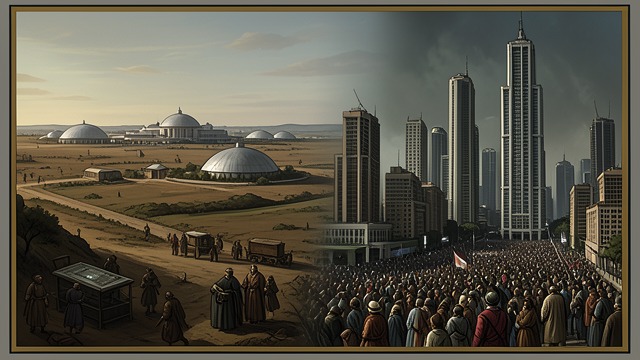
Earthmen know the Spacers largely through stories of wealth, beauty, and arrogance. Baley’s understanding is shaped by resentment and incomplete popular images.
A visible contrast
Spacetown’s low domes and open land differ sharply from the City’s towers. The contrast initially seems to confirm that the Outer Worlds possess an enviable freedom.
The comparison begins before Baley knows what that freedom costs.
Long Life and Population
Long Life and Population
Different demographic choices
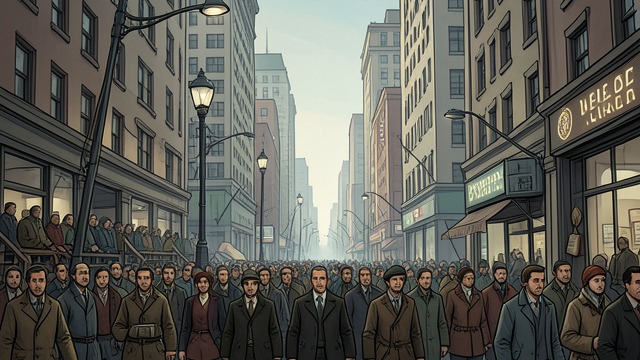
Fastolfe describes lifespans lasting centuries on Aurora and a society that tightly controls births. Earth’s crowded population and the Outer Worlds’ low population are opposing outcomes of different social priorities.
Ethical discomfort
Child screening and the prevention of population growth shock Baley. The Spacer solution preserves comfort but does so through choices Earthmen may regard as morally troubling.
Neither demographic system appears neutral or universally desirable.
The Spacer Vulnerability
The Spacer Vulnerability
Security mistaken for contempt
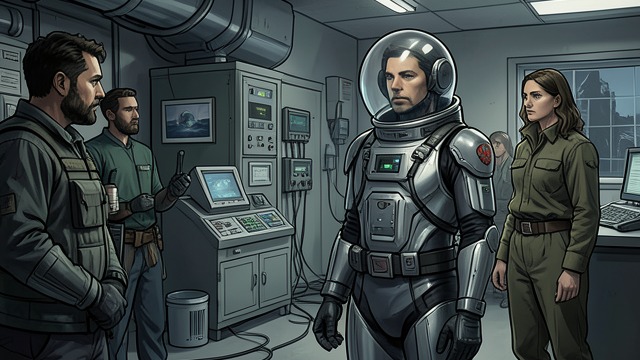
Spacers avoid Earth’s microbes because they have little immunity to diseases common on Earth. Their filters and distance are forms of self-protection rather than proof of disdain.
A fragile superiority
They conceal their fear because their prestige depends on appearing superior. Their social authority is therefore partly sustained by a misunderstanding they cannot easily correct.
The powerful are vulnerable in ways their public image hides.
Earth’s Urban Dependence
Earth’s Urban Dependence
Cooperation at scale
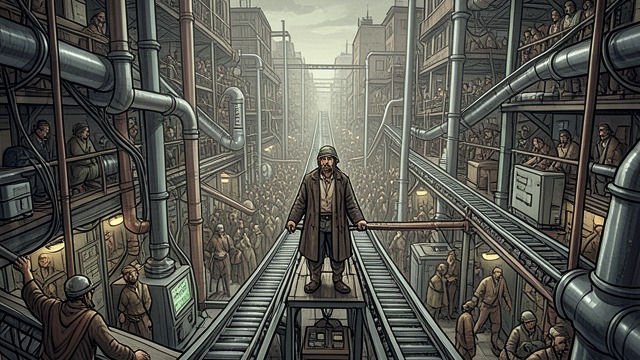
City culture coordinates food, water, transport, and waste for enormous populations. It represents a striking human achievement rather than a mere failure.
Efficiency without resilience
Fastolfe argues that the system’s complexity leaves Earth vulnerable to disruption. Baley recognizes the danger but refuses to accept that the answer is simply to abandon the City.
The critique respects the achievement while exposing its cost.
A Possible Synthesis
A Possible Synthesis
Learning in both directions
The proposed colonies would carry Earth’s cooperative culture and use robots without simply copying Spacer society. They might avoid both Earth’s overcrowding and the Outer Worlds’ excessive stability.
An uncertain hope
Baley accepts the possibility without assuming success is guaranteed. A new civilization would have to be built through choices, compromises, and human adaptation.
The novel’s future rests on synthesis rather than declaring one society superior.
During Baley’s opening journey
During Fastolfe’s explanation of Aurora
During the disease discussion in Fastolfe’s dome
During Fastolfe’s warning about the City
Near the ending, as colonization becomes a plan
